Why Your Business Is Profitable But You Still Feel Broke
🕐 Read Time 5 Minutes

Key Takeaways
A profitable business can still leave you wondering where all the money went.
More revenue doesn’t automatically lead to more cash if your expenses grow right along with it.
Profit First makes profit intentional instead of treating it as whatever happens to be left.
Your business brought in $300,000 last year. Your P&L shows a profit. On paper, things look good. So why are you still checking your bank balance before paying yourself and bracing yourself for the next tax payment?
It doesn’t feel like a business bringing in this much revenue should be this tight on cash. Your first instinct might be, I need to make more money. Sometimes, more revenue really would help. Other times, the way money moves through your business deserves a closer look.
A Profitable Business Can Still Feel Broke
Let’s say your business brings in $30,000 this month. At first glance, that sounds like a strong month. Then the bills start coming out. Payroll hits, followed by rent, insurance, advertising, supplies, loan payments, and all those other expenses that keep the business running.
By the end of the month, there’s $3,000 sitting in the account. Not bad until you realize you still need to pay yourself. Oh, and there’s a tax payment coming up. Suddenly, that $30,000 month doesn’t feel quite so successful.
A profitable P&L doesn’t necessarily mean you have plenty of cash available to pay yourself, cover taxes, or handle next month’s expenses. If this happens occasionally because of the timing of income and expenses, that’s one thing. If it happens month after month, it’s worth asking what happens to the money after it comes into the business.
More Revenue Doesn’t Always Fix the Problem
When cash feels tight, the obvious solution is to sell more. Maybe your revenue grows from $300,000 to $400,000. You’d expect that extra $100,000 to make life significantly easier.
But a funny thing can happen as a business grows: expenses grow too. You hire help because you're busier. You upgrade your software. You buy equipment that promises to make things easier. Another $49-a-month subscription sneaks onto the credit card.
None of those expenses seems like a big deal on its own. Collectively, they can eat up a surprising amount of the additional $100,000.
It’s similar to getting a raise and discovering a year later that your bank account doesn’t look much different. Your spending gradually expanded to fit your new income, and businesses can do the same thing.
Increasing revenue can certainly improve cash flow, but it works best when you also pay attention to how much of that additional revenue the business keeps.
The Problem With Whatever Is Left
Most business owners approach profit as whatever remains after the bills are paid.
There’s nothing inherently wrong with that approach. But from a behavioral standpoint, there’s one potential problem: profit gets whatever is left.
And businesses can be very good at finding ways to spend what’s available. There’s almost always something competing for the money in your account that seems useful, necessary, or justifiable.
When profit is always last in line, sometimes there isn’t much left. The cash management concept Profit First takes a different approach.
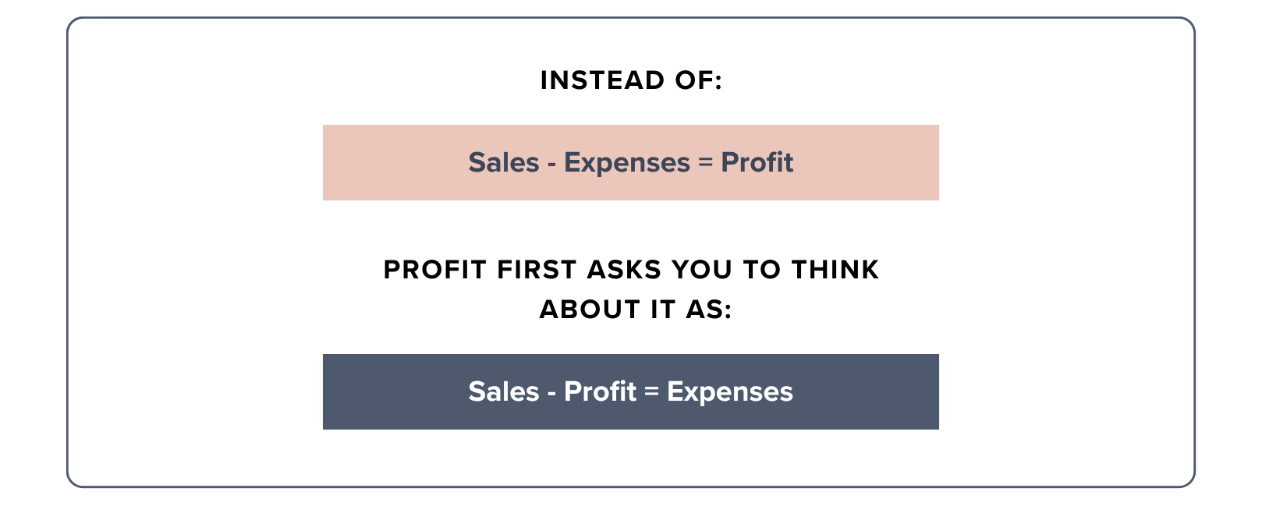
It’s the same money, but changing the order can lead to very different decisions.
Make Profit Part of the Plan
Profit First, developed by Mike Michalowicz, is built around a simple idea: plan for profit from the beginning.
Simply rearranging a formula doesn’t make your business more profitable overnight. The value comes from how the formula changes the way you think about the money available for expenses.
When profit has a place in the plan from the beginning, you start looking at spending differently. Before making another purchase, you might ask, “Does the business really need to spend this?” That small change in the question can lead to some very different decisions.
Your Bank Balance Isn’t the Entire Story
There’s another trap that’s easy to fall into. You log into your bank account, see $50,000, and assume you have room to spend. Except not all $50,000 is necessarily available.
Some of that cash may need to cover next month’s expenses. Some may need to go toward taxes or carry you through a slower season. Somewhere in there, the business also needs to provide something for the person taking the risk and doing the work: you.
That’s why managing a business by looking at the bank balance can be misleading. The number tells you how much cash is sitting there today, not how much is truly available to spend.
If you’re struggling with this distinction, our Small Business Owner’s Guide to Better Cash Flow Planning goes deeper into forecasting, reserves, and planning for the natural ups and downs of business income.
What Feeling Broke Can Tell You About Your Business
Feeling broke in a profitable business can be incredibly frustrating, but it can also be useful information. If your business brought in $300,000 last year and you’re still wondering where the money went, take a closer look at what happened to that $300,000 after it arrived.
That’s the shift Profit First asks you to make. It brings more attention to how the revenue you’re already earning moves through your business and encourages you to make intentional decisions about where that money goes.
We’ve only scratched the surface of the Profit First approach. At Financial Fitness Coaching, helping business owners understand what’s really happening with their money is central to what we do. In upcoming articles, we’ll dig deeper into how Profit First works, how business owners can put the concepts into practice, and what the system can reveal about a business’s financial health.
In the meantime, download the first two chapters of Mike Michalowicz’s Profit First for an introduction to the thinking behind the system.
Frequently Asked Questions (FAQs)
Q: Why do small businesses struggle with cash flow even when they're profitable?
A: Because profit is an accounting concept, and cash is what actually sits in your bank account. A business can show strong profit on paper while experiencing real cash shortages if clients are slow to pay, expenses are front-loaded, or money is tied up in inventory or receivables.
Q: Can financial coaching help with business cash flow planning?
A: Yes. Financial coaching can help business owners build systems, improve decision-making, identify blind spots, and create a more intentional plan for managing both business and personal finances.
Q: How often should I review my cash flow?
A: At a minimum, monthly. Weekly is better if your business has variable revenue or tight margins. Regularly reviewing cash flow makes it easier to spot issues early and make adjustments before problems grow.
About the Author Kristen Ricupero is a Certified Profit First Coach and the founder of Financial Fitness Coaching, where she helps small business owners take control of their cash flow and build businesses that actually support their lives.